
EV Maintenance Costs vs Gas: What U.S. Owners Actually Pay (2024–2025)
Disclaimer: All figures below are estimates based on historical data and industry reports. Actual costs vary by model, region, driving habits, and current market conditions. Always verify with your manufacturer and local shop before budgeting.
Are EVs Cheaper to Maintain Than Gas Cars?
Short answer: yes, on scheduled maintenance alone.
According to U.S. Department of Energy estimates, battery-electric vehicles (BEVs) averaged roughly 6.1 cents per mile in scheduled maintenance versus approximately 10.1 cents per mile for internal combustion engine (ICE) vehicles. At 15,000 miles per year, that's roughly $915/year for EVs versus about $1,515/year for gas cars — a gap of around $600 annually. (Source: DOE FOTW #1190, 2021; these are estimates only.)
Consumer Reports data corroborates the trend, showing EV owners typically spend less on maintenance and repairs over a vehicle's lifetime.
Why EV Maintenance Costs Are Lower
-
Fewer moving parts: No oil changes, timing belts, spark plugs, or transmission fluid services.
-
Regenerative braking: Extends brake pad and rotor life significantly — often 2–3x longer than gas cars under normal driving.
-
No exhaust or emissions systems to service.
The Hidden Costs Nobody Talks About
Tires: The Biggest Recurring EV Expense
EVs are heavier and deliver instant torque, accelerating tire wear. Industry estimates suggest EV tires may wear faster than comparable ICE tires. Budget accordingly — tire replacement is often the single largest recurring maintenance cost for EV owners.
Collision Repairs Cost More
Post-accident repair bills for EVs run higher than for gas vehicles. Q1 2024 industry data (Mitchell/InsideEVs) estimated average EV collision repair costs at roughly $6,066 versus approximately $4,703 for ICE vehicles. (These are historical averages; current costs may differ.)
Why? High-voltage safety procedures, OEM parts dependency, aluminum body structures, and ADAS recalibration all add labor and parts costs.
Battery Replacement Risk
Most modern EV batteries degrade slowly, and many owners never need a full replacement. When replacement is necessary, industry estimates range from roughly $5,000 for module-level repairs to $15,000–$20,000+ for a full pack on larger vehicles. (These are rough industry estimates, not manufacturer prices.)
EV Battery Warranty: What to Know
Most U.S. manufacturers offer 8-year/100,000-mile battery coverage as a baseline. Key details to verify before buying used:
-
Capacity threshold: Many warranties only trigger below ~70% state of health.
-
Transferability: Some warranties don't transfer to second owners.
-
Exclusions: Physical damage, floods, and unauthorized mods typically void coverage.
Quick Cost Comparison
Table
| Cost Factor | EV Estimate | Gas Car Estimate |
|---|---|---|
| Scheduled maintenance (per mile) | ~6.1¢ | ~10.1¢ |
| Annual scheduled maintenance (15k mi) | ~$915 | ~$1,515 |
| Avg collision repair (Q1 2024) | ~$6,066 | ~$4,703 |
| Major repair risk | Battery ($5k–$20k+) | Engine/transmission ($3k–$8k+) |
Sources: DOE 2021; Mitchell/InsideEVs Q1 2024. All figures are estimates.
How to Lower Your EV Maintenance Costs
-
Rotate tires every 7,500 miles — EV weight accelerates wear.
-
Charge to 80% for daily use — slows battery degradation.
-
Avoid frequent DC fast charging — reduces long-term capacity loss.
-
Use regenerative braking — extends brake pad life.
-
Follow the manufacturer's service schedule — don't skip coolant or 12V battery checks.
-
Get certified EV shop estimates — labor and diagnostic accuracy vary widely.
Bottom Line
EVs generally win on scheduled maintenance costs, but tires, collision repairs, and potential battery replacement can erase some of those savings depending on your model and driving habits. Fleet-wide averages are a starting point — your actual costs depend on the specific vehicle, climate, and service history.
Sources: DOE Office of Energy Efficiency & Renewable Energy; Mitchell International; InsideEVs; Consumer Reports. This article is for informational purposes only and does not constitute professional automotive or financial advice.
EV Risk Index: a smarter way to manage model-specific risk
Scheduled maintenance averages tell you what a typical EV owner pays. They do not tell you what a specific model, in a specific climate, with a specific service history, is likely to cost you. That gap is where owners get surprised.
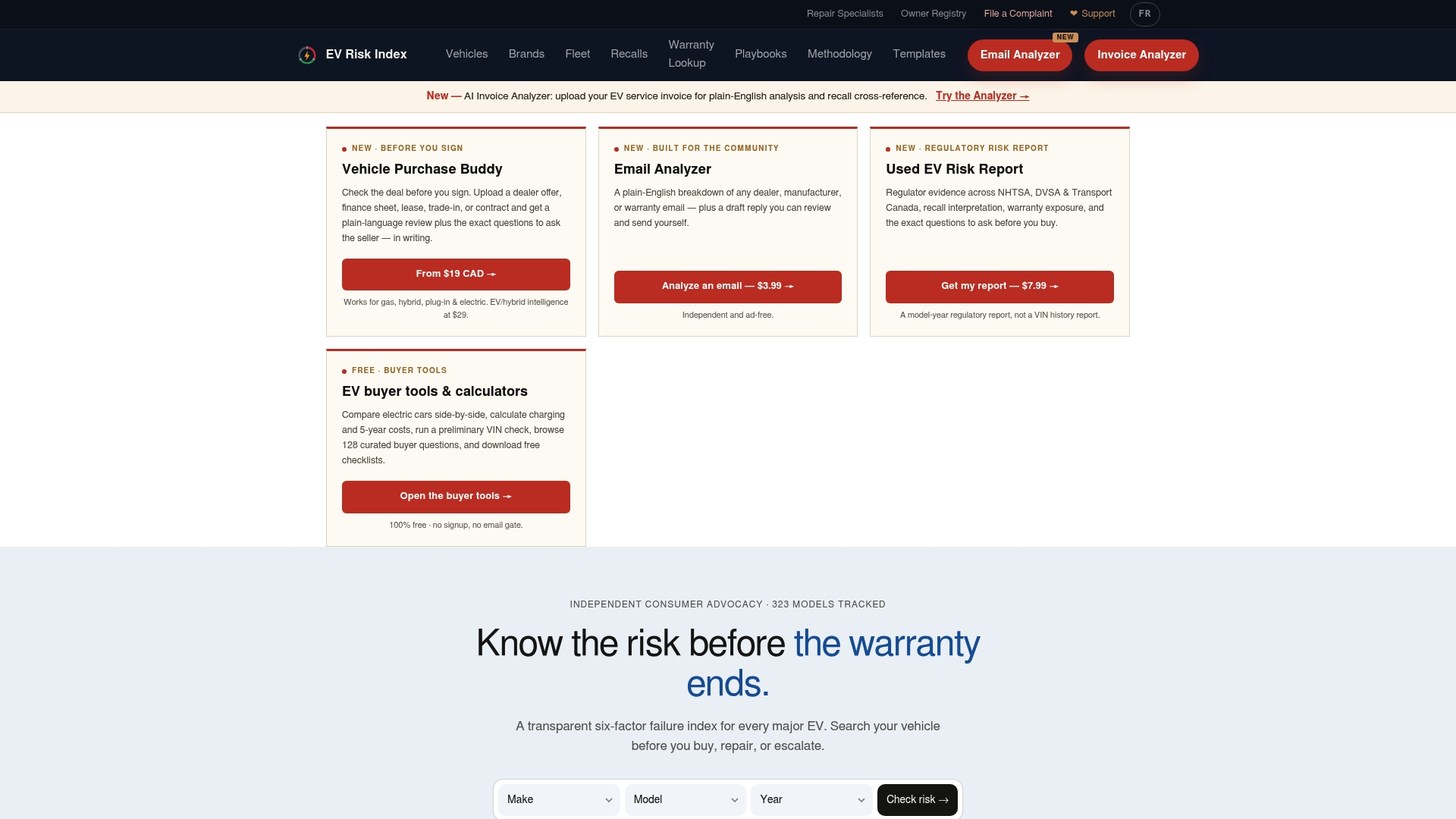
EV Risk Index closes that gap. The platform aggregates recall data, reliability signals, and repair invoice intelligence into model-specific risk assessments, giving you a clearer picture before you buy or before you authorize a repair. The AI Invoice Analyzer reviews dealer and shop invoices for hidden labor charges and missed warranty claims. The Vehicle Purchase Buddy turns recall history and known component risks into a structured purchase checklist. And the Email Analyzer helps you evaluate seller communications before you commit.
If you are buying a used EV or facing an unexpected repair bill, start with EV Risk Index to get the model-specific context the averages cannot give you.